Showing posts with label Platinum. Show all posts

21 March 2026

Confessions of a Spanish Pen Addict. III.

The third and last article of the Confessions of a Spanish Pen Addict appeared in issue 77 (nominally April 2026) of Shumi-no Bungubako (趣味の文具箱). I say final because I have decided to discontinue this collaboration due to the strict internal censorship that forms part of the magazine's editorial policy.

The ostensibly subversive subject of these particular Confessions is the story of the Presidente pens marketed in Spain around 1960. The original text reads as follows:


A Very Spanish Pen (Made in Japan)

In Madrid, every Sunday an immense and ever-growing flea market takes place along Ribera de Curtidores street. And, as in most street markets, what someone else might discard is for you to buy. There, at one stall, I saw an array of unused fountain pens, neatly arranged. They were claimed to be Presidente, a minor Spanish brand legally registered by a certain Doroteo Pérez y Pérez, whose business was located at number 8, Calle del Príncipe Pío, Madrid, in 1959.

The luxury Presidente. Photo by Tommy Lanceley

In actual fact, however, those pens proved to be Platinum pens.

Further research in Spain showed that there appear to be only three models of Presidente pens, albeit with some color variations―black, grey, red, and blue. All three feature the Platinum globe logo with the letters S and N (after Shun-ichi Nakata, 中田俊一, founder of Platinum) engraved on the cap and on the nib. One of them even carries the name Platinum engraved on the nib, whereas the other two are imprinted with the brand name “PRESIDENTE” above the Platinum logo. In any event, the Spanish brand is always prominently engraved on the barrel: “PRESIDENTE / Registrada.” Inside, the filling system also bears the Spanish brand, together with instructions on how to fill the pen, written in imperfect Spanish.

Presidente and Platinum logo.

All of them are aerometric fillers―bladder type with an internal compensation tube― with nail-shaped steel nibs, very similar to the Honest models made by Platinum in the early 1950s. Those models evolved into the Honest 60 in 1956–57, when Platinum decided to say “farewell to ink bottles” and marketed the first ink cartridges in Japan, thus abandoning self-filling mechanisms.

In 2013, at the now-discontinued Mitsukoshi Stationery Festa, the seasoned Platinum craftsman Mr. Masayoshi Nakanishi (中西正好) examined my Presidente pens. He immediately recognized them as Platinum products:

“Oh, that was the luxury model! Be careful with the clip, as it is a bit fragile.”

At the same time, however, he explained that there were no company records of contacts or transactions dating so far back. Consequently, Platinum as a company could not say much―if anything―about these somehow Spanish Platinum pens: pens bearing engravings and instructions in Spanish, sometimes incorrect Spanish.

Publishing this information online prompted several fellow aficionados from around the world to share their own knowledge. We then found out that there had been other cases of foreign-branded Platinum pens besides the Spanish one. In South Africa, the brand Hifra marketed similar models dating from the 1950s, as well as more modern Platinum “pocket pens” later in the 1960s. In Greece, the brand Joker also used a couple of Platinum models in its operations. In this latter case, the pen box carried two brand names―Joker and Platinum.

Honest models by Joker (top), Hifra (middle), and Presidente (bottom).

Joker AND Platinum.

Were there more operations like these? In the absence of written records in Platinum’s archives, it is not possible to decide one way or the other. We do know, however, that such operations existed and that they had a very loose connection to Platinum in Japan.

Once again, the pen community proved to be essential in providing information beyond what official records might reveal. There is always something hidden in plain view at flea markets around the world.

I am merely the writer of this story, populated by a number of characters. Eduardo Alcalde, Miguel Huineman, Salvador Maturana, Toshiaki Sugimoto (杉本寿明), Kostas Kouvaris, Alberto Linares, and Masa Sunami (すなみまさみち) contributed by offering information and expertise.


RomilloPens Wi Toledo – Pilot (Thai) Black

Bruno Taut
January 2026 and March 17th 2026
etiquetas: Platinum, Presidente, Joker, Hifra, publicaciones

09 August 2023

Hifra Again

Hifra, Joker and Presidente are three brands I have documented on these texts with the help of some friends from a number of countries. These brands, let us remember, were operations that used Platinum pens as their own in the late 1950s in their own countries: Hifra in South Africa, Joker in Greece, and Presidente in Spain.

Among them, Hifra seems to be the better established company, and used more Platinum models –among some others-- and its operation extended beyond those late 1950s. And today, I am showing one more of those pens—a Sheaffer inspired pen.

A Hifra pen. On the barrel, "HIFRA" / TRADE (logo) MARK / REG 85809 / 4415 .

This Hifra is an aerometric filler with a metallic cap and a black body. The nib is an inlaid unit with a close resemblance to some Sheaffer nibs. These are its dimensions:

Length closed: 135 mm
Length open: 118 mm
Length posted: 153 mm
Diameter: 16 mm
Weight: 18.3 g (dry)

The insides. A bladder-type filler.

The nib: HIFRA / SUPERIOR / 105-PEN .

Platinum, could not be otherwise, used these inlaid nibs in several pens during the 1950s.

A similar nib in a President pen, one of the brands historically used by Platinum.

But all in all, the whole pen is very close to some Sheaffer models of the time. On the picture, a Sheaffer Sentinel.

Sheaffer Sentinel.


Moonman T2 with Bock nib – Pilot (Thai) Black

Bruno Taut
August 9th, 2023
etiquetas: Hifra, Platinum, Sheaffer

28 July 2023

Japanese Workhorses in 2023

We have just seen that the Pilot's model Custom 74 has been in the market for over 30 years. But what about the direct competitors in the Japanese market?
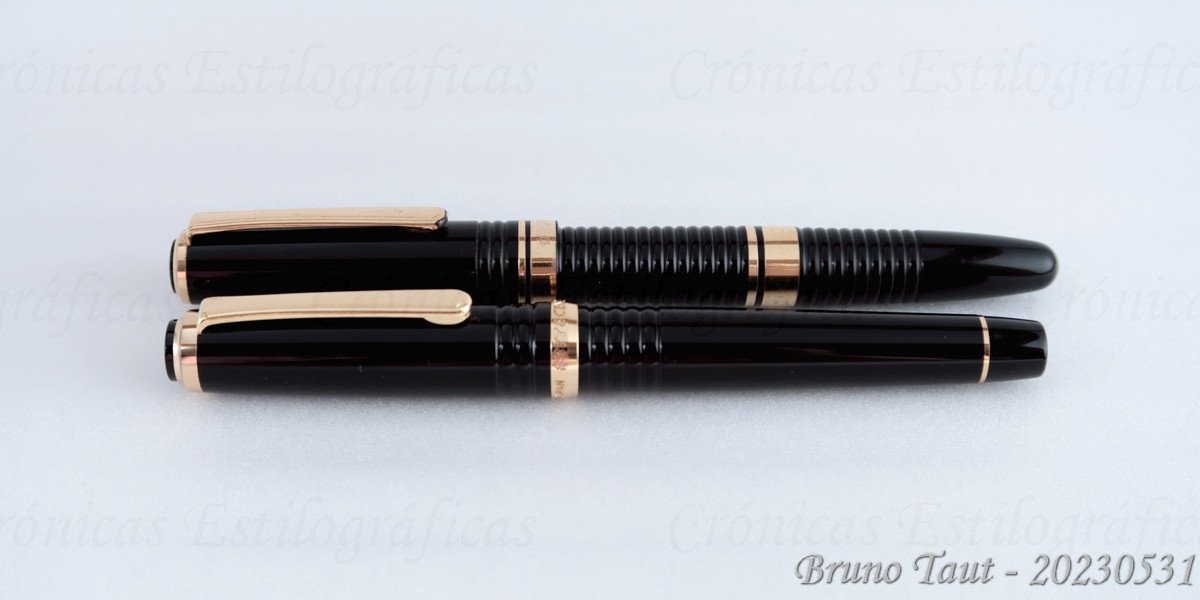
The three contenders. From back to front, Platinum 3776 Century, Pilot Custom 74, and Sailor Standard Profit.

Platinum had released the 3776 model in 1978, but this model has gone through a number of modifications over the years, as we had seen in previous texts. The latest iteration, so far, is the 3776 Century initially released in 2012. At the time, the Century's price was JPY 10000, and it had eight nib options, although the model with the music nib was more expensive at JPY 15000. All of them were made of 14 K gold.

Platinum 3776 Century Bourgogne, M nib. This color variation does not convey any overprice. JPY 10000 in 2012, JPY 20000 in 2023.

Sailor had marketed the Profit model in 1983 based on the 70th anniversary pen of 1981. In 2003-04, the current version saw the market—two cap rings, new nib decoration, etc. By 2012, our reference year, the Standard Profit cost JPY 12000 and offered seven nib options. Should you want a 21 K gold nib in the same size, the price was JPY 15000.

Sailor Standard Profit, F nib. JPY 12000 in 2012, JPY 13000 in 2023.

In that same year of 2012, Pilot's Custom 74 with the size 5 nib in 14 K gold had a total of eleven nib options: nine of them for JPY 10000, and two, music (MS) and coarse (C), for JPY 12000.

Pilot Custom 74 with SM -soft medium- nib. JPY 10000 in 2012; JPY 12000 in 2023.

How are these pens in 2023?

The Pilot Custom 74 costs now JPY 2000 more: JPY 12000 for most of the nib points, and JPY 14000 for MS and C nibs.

Platinum has increased the prices a lot more: JPY 20000 for the basic version, and JPY 28000 for the Century with music nib.

Finally, Sailor also increased the prices to JPY 13000, plus an additional hike to JPY 15000 for the zoom and music nibs. (The 21 K option became JPY 22000, and JPY 25000, respectively).

In all three brands, the number of nib options remains untouched, although Pilot did release an new variation—the S, signature—that is not shown in the catalog.

So, after 10 years, these old pens are still the workhorses of their companies, but the changes in their prices have altered their relative positions with respect to each other.

Pilot is now the cheaper option while having the highest number of nib options.

Platinum's Century is now in a higher price range. This pen is now on par with the Pilot Custom 742 (size 10 nib), but the Pilot offers many more nib points in that pen—16.

Platinum 3776 Century with music nib. It went from JPY 15000 to JPY 28000.

Sailor's price hike was, proportionally, lower than those by Platinum and Pilot, but still high enough to become more expensive than the Pilot Custom 74. However, Sailor's problem might be different—the immense number of variations in the form of “shop-original pens” creates a complex scenario where the basic Standard Profit became buried if not invisible.

So, the conclusion is that, in this context, the Pilot Custom 74 becomes even more desirable than 10 years ago.

(All prices quoted without taxes. In Japan, VAT is 10%).


Moonman T2 – Pilot Black (Thai version)

Bruno Taut
July 28th 2023
etiquetas: Pilot, Platinum, Sailor, mercado

16 July 2023

Signature (I)

Last year, 2022, Pilot released a new nib point for the model Custom 742—the Signature. And by doing this, the number of points available in Pilot's size 10 nibs (::1::, ::2::) is 16.


The Signature point—a sort of smooth stubbish broad nib— is not particularly new. In Japan they existed in the 1960s and 1970s by the hand of Pilot and Platinum. On the picture we can see two of those together with the new Custom 742.


Now, do they draw a similar line? Or, in other words, are all Signature nibs alike? Not really, and the larger differences are between those made by Pilot—a smooth broad nib with a stubbish character on the 742, and a very round symmetric point on the Pilot E from 1968. On its side, the Platinum pocket pen, also from 1968, is more of a stub nib, with an overall width finer than that of the Custom 742. So it might be worth to reflect on those names and their definitions at some point.


Anyway, the Custom 742 with Signature nib adds even more value and appeal to the Pilot lineup of nibs, particularly to the size 10. 16 different points in a single pen model is not something any other company currently could brag about.


Pilot Custom 742 - Diamine Imperial Purple.

Bruno Taut
July 14th, 2023
etiquetas: Pilot, plumín, Platinum

10 June 2023

The Odd Relative: Platinum Glamour

After writing about the Platinum 3776 and its more than 40 years of history, it is only natural to mention its weird relative, the Platinum Glamour marketed in 1987.


The reason for this is clear—not only the Glamour follows the style of the original 3776 of 1978, but also Platinum described it as a modification of that model “by giving it a thicker body but making it compact”. And on the pen box Platinum added “a sense of proportion in deformation”.

"A sense of proportion in deformation. An attractive design”. Platinum dixit.

Well, not the strangest argument in marketing, but certainly paradoxical.

In any event, the interesting detail of the Glamour, beyond its deformed shape, is the fact that Platinum had to create a specific nib –with its corresponding feed—to create that pen. In this regard, it relates to the limited release 3776 Decade and its original nib.

The gold nib (14 K) of the Glamour. It also exists in steel.

Back in 2010 I published a review of the Glamour with a gold nib—more comfortable than what its shape and size might suggest, a stiff nib, and a high price. And right now, even more expensive.


Sailor Mini (1971), 21 K - Sailor Blue

Bruno Taut
June 10th, 2023
labels: Platinum

01 June 2023

New 3776 Nib

The Platinum Decade pen described on the previous entry implements, as we saw, a new nib. And this nib represents a new step in the evolution of the 3776 nib.

So this is a good time to revise that evolution of nibs and feeds along forty-something years of history.

Early models, (between 1978 and some time in the early 1980s) had very cylindrical nibs and ebonite feeds. The first year model had a feed with no fins at all. There were also music nibs with this geometry.


Nib and feed of a Platinum #3776 from 1978. Note the ebonite feed.


The feeds of these early models changed quickly. By the second year, they had implemented some fins.

Later on, the nib became flatter on the top area, but there were few, if any, changes on the ebonite feed. This detail changed at some point and from then on all Platinum feeds have been made of plastic.


Nib and feed from 1984. The nib is obviously flatter on top while the feed is still made of ebonite.


Nib and feed from 2002. The nib is apparently identical to the previous one (1984), but the feed is now made of plastic.


Nib and feed from a #3776 Century. Labeled as manufactured on November of 2011. Note the shorter nib and the very specific feed. Needless to say, it is made of plastic.

The #3776 Century was launched in 2011. On this newer edition, two-tine nibs (i. e., non music nibs) changed with respect to previous models. Now they are shorter than before, and the feed had been modified to anchor the nib on the right position.


On the left, a music nib of a #3776 Century, dated on 2012. On the right, a music nib of a #3776 of 2009. The feeds are identical. The nibs share the same basic geometry.


Music nib and feed of the Wagner 2015 pen. Note the absence of holes in the tail of the nib.

These changes, as I said, did not affect the three-tine music nibs. In some occasions, some gold was removed from the tail of the nib –that area hidden under the section-, but is also seems not to be always the case. The feeds of these music nibs are more cylindrical in shape and have no fixed position for the nib.


Two and three tine nibs dated in 2009 and 2010. They were interchangeable in their sections. I am well aware that the two tine nib is a Nakaya, but Nakaya implements #3776 nibs.

And in 2022, the model released to celebrate the 10th anniversary of the 3776 Century sported the following nib:


It is slightly narrower and longer than the previous nib. The feed remains untouched.

Now, the question is whether this new nib will become the standard for all 3776 Century and associated products (::1::, ::2::). Time will tell.


Pilot Custom 742, S nib – Diamine Imperial Purple

Bruno Taut
June 1st, 2023
etiquetas: Platinum, plumín, plumín musical

31 May 2023

Decade

One of the most interesting pens released in 2022 was the Platinum Decade, made to celebrate the 10th anniversary of the model 3776 Century. And it is interesting because it somehow departs from the very trite trick of rehashing a well known model by simply changing the color.

The Platinum Decade in the box.

For this pen Platinum changed two elements with the result of a more attractive pen:

The first is the overall shape and style—gathered ma-non-tanto. Like the first edition 3776 of 1978, but not too much. The gathered style, let us remember, remains in the Platinum catalog to this day after a numerous adaptation to the successive changes in the model.

A collection of 3776 models, plus the Platinum Glamour.

Platinum Decade (bottom) and 1978 Platinum 3776 (top).

The result, the Decade pen, recalls the old model while also being new.

The second detail that makes this pen different is the nib. As can be seen on the picture, Platinum took the effort of designing a new geometry for the nib instead of simply implementing the old Century unit.

The two nibs, side by side. The Platinum Decade on the left, a regular 3776 Century on the right.

This is a lot more than what Platinum has been doing in the last years—endless variations of the 3776 Century by changing colors and textures, all of them with the same nib.

So Platinum now deserves some recognition.


Parker 51, burgundy – Sailor Tomikei Blue

Bruno Taut
May 31st, 2023
etiquetas: Platinum, plumín, mercado

27 April 2023

New Izumo (II)

As we saw yesterday, Platinum has announced a new Izumo series of pens with a relatively new nib—a #3776 made of 18 K gold.

It could be argued that Platinum had paid attention to a typical complain—the President nib looks small on the Izumo pen. But how do President and #3776 nibs compare? Is the #3776 unit going to correct that perception?


The fact is that the #3776 is just slightly bigger than the President, as the following table shows:


. President .
18 K Au
.#3776.
. 14 K Au .
Total length (mm) 25.5 29.1
Exposed length (mm) 20.9 21.8
Width (mm) 8.1 8.6
Weight (g) 0.6 0.7

And a similar effect can be seen when comparing a #3776 Century and a President pen side by side. These two pens are very similar in dimensions.

President (top) and #3776 Century (bottom).

Izumo Akatamenuri (top) and President (bottom).

On the Izumo, the problem is the actual girth of the pen, significantly larger than that of the regular President:

Izumo
.Akatamenuri.
.President. #3776
.Century.
Length closed (mm) 155 143 140
Length open (mm) 134 122 120
Max. diameter (cap) (mm) 17.5 16.0 15.3
Barrel Diameter (mm) 15.7 13.4 13.3

So, will the #3776 nib correct the perception of a small nib attached to a big pen? Only marginally, I'm afraid.

The actual problem of Platinum is the lack of a big nib, a nib comparable to the Sailor super big (King of Pen) or to the Pilot size 30 (Custom Urushi). And that is a serious handicap if you wanted to design and produce a big pen.


Pilot Custom 74, Yamada Seisakusho – Diamine Teal

Bruno Taut
Yokohama, April 26th, 2023
etiquetas: plumín, mercado, Platinum

26 April 2023

New Izumo (I)

Platinum has just announced a new release of the well-known Izumo series of pens.

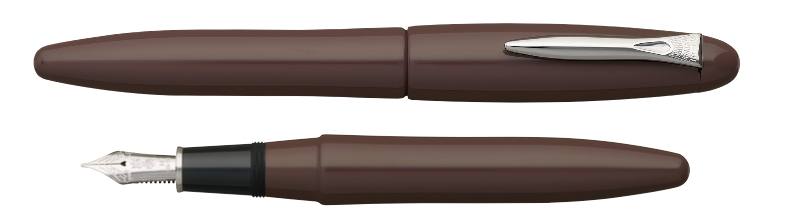
The name of this new variations is Iro Urushi, colored lacquer, and is composed by two models –Aitetsu Iro, a bluish green pen; and Budô Nezu, brown with greyish tones.

Platinum Izumo Iro Urushi Aitetsu Iro.

Budô Nezu Izumo. Note the silver trim on both pens.

But what might be more relevant to this new pens is the implementation of a different nib with an additional nib point. Traditionally, Izumo pens sport President nibs of 18 K gold with points F, M and B. The exception are the models made of weaved bamboo –the Yokoajiro and the Gozame with catalog references PBA–120000Y, and PBA-120000G, whose nibs are of the #3776 type.

The new nib. Or not so new. And for the first time, there will be Izumo pens with BB points.

And these #3776 nibs, rhodiated and made of 18 K Au, will also be used on the new Iro Urushi Izumo pens with the options of F, M, B and BB points.

Two questions remain open: will these #3776 nibs be implemented on the existing spindle-shape Izumo pens? How much will these Iro Urushi pens cost?

Parker 51 burgundy – Tomikei Blue (Sailor)

Bruno Taut
Yokohama, April 26th, 2023
etiquetas: plumín, maki-e, mercado, Platinum